All Caithness Astronomy Group events are on their own web site now at http://www.spanglefish.com/caithnessastronomygroup/
July 07
Perseid Meteor Shower In August
(peaks on 12/13th Aug). This year is a good chance to see them as the
sky will be moon free, meaning it will be nice and dark and ideal for
observing if the weather plays along.
Some related web links are:
Great Perseids From NASA
Meteor Shower
Meteors
20 June 07
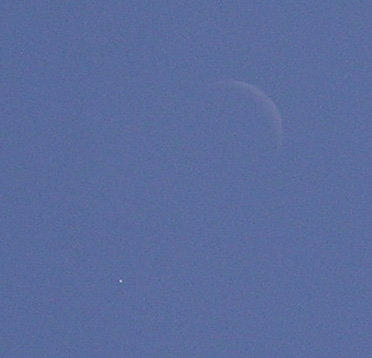
Venus Visible In Daytime In Caithness
 Very observant people might
have noticed a thin crescent Moon just visible in the bright
sun-drenched afternoon sky on Monday (18th June). Those that looked
even closer would probably have been surprised to see what would have
looked like a star beside it. This was the planet Venus, shining so
brightly that it was visible to the naked eye even in broad daylight. Very observant people might
have noticed a thin crescent Moon just visible in the bright
sun-drenched afternoon sky on Monday (18th June). Those that looked
even closer would probably have been surprised to see what would have
looked like a star beside it. This was the planet Venus, shining so
brightly that it was visible to the naked eye even in broad daylight.
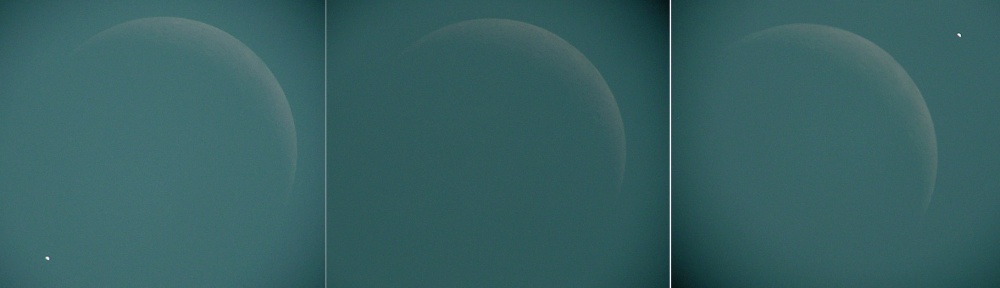
If you looked
at the wrong time though Venus would not have been visible as it
disappeared behind the Moon for an hour or so. See below a sequence of
photos showing (left to right) the before, during and after views of
this daytime "eclipse".
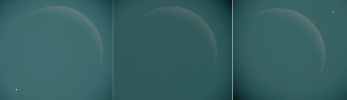
Looking closely
at the photo you'll see that Venus is currently crescent shaped. This
crescent will become thinner and longer over the coming month as the
planet comes closer to the Earth and more into alignment between the
Earth and Sun. By mid July binoculars will clearly show this crescent
shape. Another sight to watch out for in the near future is the close
encounter of Venus with Saturn in the late evening sky on 31st June and
1st July.
3
June 07
Planet Spotting In June Pdf
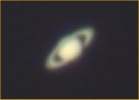 As
the summer nights shorten over the coming month we'll be treated to
plenty of opportunities for evening views of the planets Venus, Saturn
and Jupiter, with Mercury also joining the show for a short while.
These planets are all visible to the naked eye and should be easy to
identify, but unfortunately they will be quite low in the sky so a
fairly clear horizon will be needed. Venus, Saturn and Mercury (&
occasionally the crescent moon) can be seen lined up in the north
western sky shortly after sunset and the giant planet Jupiter can be
seen rising to low above the southern horizon around midnight. As
the summer nights shorten over the coming month we'll be treated to
plenty of opportunities for evening views of the planets Venus, Saturn
and Jupiter, with Mercury also joining the show for a short while.
These planets are all visible to the naked eye and should be easy to
identify, but unfortunately they will be quite low in the sky so a
fairly clear horizon will be needed. Venus, Saturn and Mercury (&
occasionally the crescent moon) can be seen lined up in the north
western sky shortly after sunset and the giant planet Jupiter can be
seen rising to low above the southern horizon around midnight.
April 2006 (Pdf
file)
This months newsletter is packed with information that will be useful
to anyone new to looking at the night sky. Lots of links to
useful web sites and photos from the Caithness night sky. In May there
is a visitor in night sky as Comet 73P/Schwassmann-Wachmann 3 passes
earth.
This May sees a favourable flypast of this
interesting comet which fragmented during its 1995 circuit around the
Sun. The brightest fragment (component C) will pass closest to the
Earth (a mere 6.5 million miles!) on the 12th May.
February - March 2006
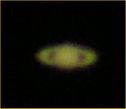
Photographs Of The Night Sky
From Caithness
The
Night Sky From Thurso
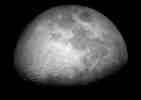
5 March 2007
Lunar Eclipse 3 March
2007
A range of photos and a video
20
February 07
Caithness Skies - Lunar Guide (Pdf)
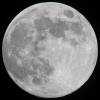 Over the next couple of weeks the Moon will be
involved in a few interesting celestial events: Over the next couple of weeks the Moon will be
involved in a few interesting celestial events:
Total Lunar
Eclipse (3rd March 2007)
On this evening the Moon will pass into the Earth's shadow and
"disappear" from view. This will be about as good an opportunity as
you'll get for observing this phenomenon. It begins around 2130hrs and
lasts until approx 0115hrs with the Moon totally eclipsed for just over
an hour in the middle of this period. This event can be clearly seen
with the naked eye.
Occultations
(the Moon passes in front of other celestial objects) - On the 23rd of
February 2007 (approx 2200-0000hrs) the Moon will pass in front of the
Pleiades star cluster resulting in the stars disappearing from view and
then reappearing on the other side of the Moon about an hour later.
Binoculars will afford a good view of this.
- During the
early hours of the 2nd of March (approx 0220-0250) the planet Saturn
will be occulted by the Moon. A small telescope will give the best view
of this ringed planet temporarily disappearing behind the Moon.
Whilst viewing
the above events there is time to look for the detail described in the
attached Lunar guide. The Moon truly is an interesting and easy object
to observe and is well worth a close look.
10 February 07
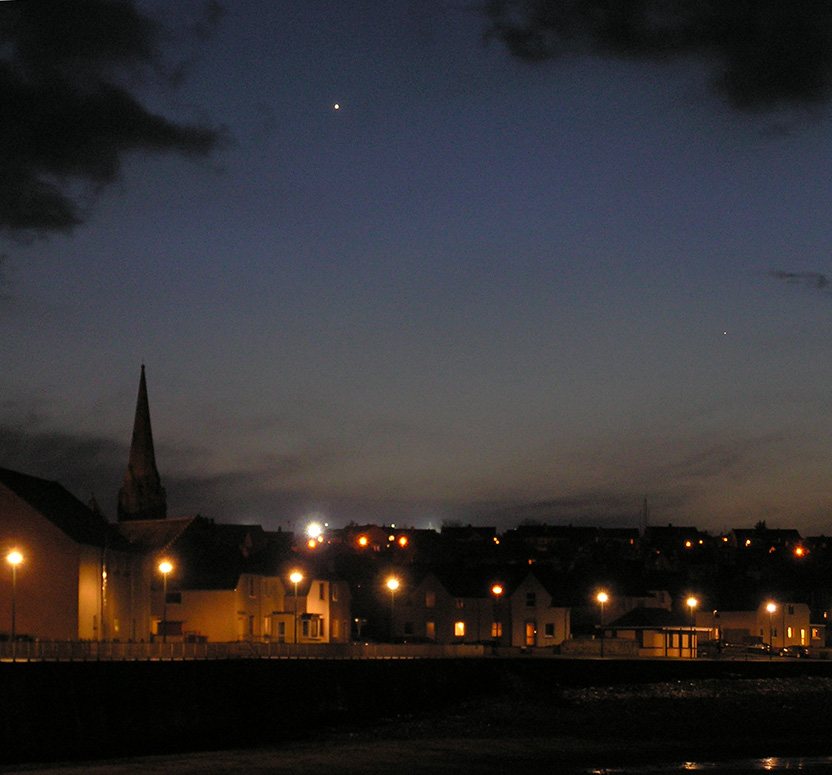
Venus and
Mercury Over Thurso
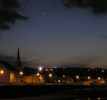 Gordon
Mackie said,"I took tonight (9th) & it shows the unmistakably
brilliant planet Venus shining alongside the fainter planet Mercury.
For the next 4-5 days the pairing can be seen side by side, low in the
western sky shortly after sunset. By next weekend Mercury will become
too close to the Sun to be visible, leaving the prominent Venus on its
own in the sky at sunset for the next few months. After spotting these
two planets turn and look east to find the bright planet Saturn rising
above the eastern horizon." Gordon
Mackie said,"I took tonight (9th) & it shows the unmistakably
brilliant planet Venus shining alongside the fainter planet Mercury.
For the next 4-5 days the pairing can be seen side by side, low in the
western sky shortly after sunset. By next weekend Mercury will become
too close to the Sun to be visible, leaving the prominent Venus on its
own in the sky at sunset for the next few months. After spotting these
two planets turn and look east to find the bright planet Saturn rising
above the eastern horizon."
10
January 07
Comet McNaught Heads for The Sun
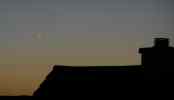 This
comet is clearly visible to the naked eye very low in the sky near the
Sun just before sunrise (SE) or at sunset (SW). Attached are photos of
it taken as the sky was brightening on the morning of 8th January.
Unfortunately it will soon (by the end of this week) be too close to
the Sun to see it. You'll need clear skies similar to those on recent
mornings to see it - good luck! This
comet is clearly visible to the naked eye very low in the sky near the
Sun just before sunrise (SE) or at sunset (SW). Attached are photos of
it taken as the sky was brightening on the morning of 8th January.
Unfortunately it will soon (by the end of this week) be too close to
the Sun to see it. You'll need clear skies similar to those on recent
mornings to see it - good luck!
8
January 07
Night Sky
Over Thurso 3 December
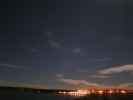 Stewart
Watt send in this photo of Orion over Thurso taken on 3 December 2006. Stewart
Watt send in this photo of Orion over Thurso taken on 3 December 2006.
3
January 07
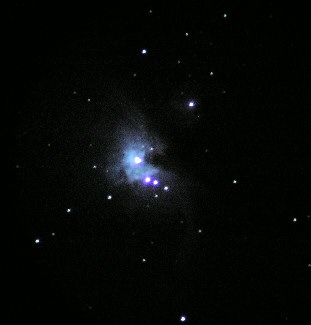
Below are a couple of photos
I took during recent clear nights
- anyone
with binoculars or a small telescope will be able to view these objects
in similar detail.
3 January 07
Beginners
Guide To the Winter Night Sky
Click the link for a guide giving
some of the highlights to be found in the winter night sky. This will
be useful to anyone that received a telescope/ spotting scope or
binoculars for Christmas and wants to know what in the night sky would
be interesting to look at.
3 January 07
Aurorae
For those that enjoy aurorae, the active sunspot that caused the bright
aurorae in mid December is now re-appearing form the other side of the
Sun (rotational period of the Sun is about 4 weeks and the sunspot has
spent the last 2 weeks transiting the other side of the Sun). There is
therefore the possibility of similar auroral displays over the next
week or two. Updates on the likelihood of a display (cloud cover
permitting of course) can be obtained at http://spaceweather3.com/
and
http://www.sec.noaa.gov/pmap/index.html
1
May 06
Comet
Update - Comet 73P/Schwassmann-Wachmann 3
 The month of May 2006 will provide an opportunity
for some interesting objects to be observed in the night sky with no
more than a pair of binoculars, with some even being visible to the
naked eye. Unfortunately true darkness does not fall until around
midnight, but if you're up late at night or very early in the morning
why not take a look at what's up there. As mentioned in the recent
newsletter this comet, or at least the many parts of it (there are
currently 38 individual fragments being tracked by astronomers!) will
pass close to the Earth (a mere 6.5 million miles!) during the month of
May. It is being watched with great interest by astronomers and they
have recently observed one of the brighter fragments break into two: The month of May 2006 will provide an opportunity
for some interesting objects to be observed in the night sky with no
more than a pair of binoculars, with some even being visible to the
naked eye. Unfortunately true darkness does not fall until around
midnight, but if you're up late at night or very early in the morning
why not take a look at what's up there. As mentioned in the recent
newsletter this comet, or at least the many parts of it (there are
currently 38 individual fragments being tracked by astronomers!) will
pass close to the Earth (a mere 6.5 million miles!) during the month of
May. It is being watched with great interest by astronomers and they
have recently observed one of the brighter fragments break into two:
13 March 06
Perseus and Cassiopeia 21
February 2006
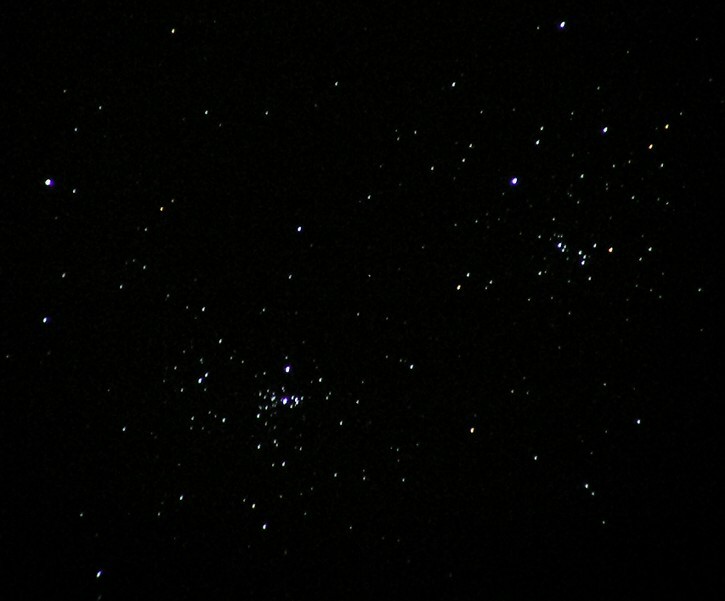
Gordon Mackie has sent in a
photo of the constellations of Perseus and Cassiopeia. The Milky Way
runs through these constellations, so a sweep with binoculars will not
disappoint. One particular area to check out with binoculars or a small
telescope is marked on one version of the photo - this is where The
Double Cluster (NGC 869 and NGC 884) can be found. In clear skies it
can be spotted with the naked eye, but its true glory is only revealed
with optical aid. Have a look.
19
February 06
Caithness Night Sky Section Begins
Welcome to the Caithness Night Sky.
Gordon Mackie has long been interested in astronomy and has kindly
offered to contribute to this new section.
This section will consist of a
bi-monthly newsletter with photos and information about what might be
seen in the night sky over Caithness. A photo gallery will shortly be
added where anyone can send in their photos of the Caithness Night Sky.
Gordon has offered to answer
questions which can initially be emailed to bill@caithness.org for
forwarding.
To start the section going Gordon
has prepared a February March 2006 newsletter with details of what he
has seen recently. He starts by including items that can easily
be seen with the naked eye or binoculars. If there is enough
interest Gordon will move into more technical descriptions at a later
date.
At the end of the newsletter are
details of events or items to look out for in coming weeks.
Anyone can contribute to this new
section and Gordon is keen to stimulate interest. Let us have
your suggestions and ideas and we will consider them.
|